

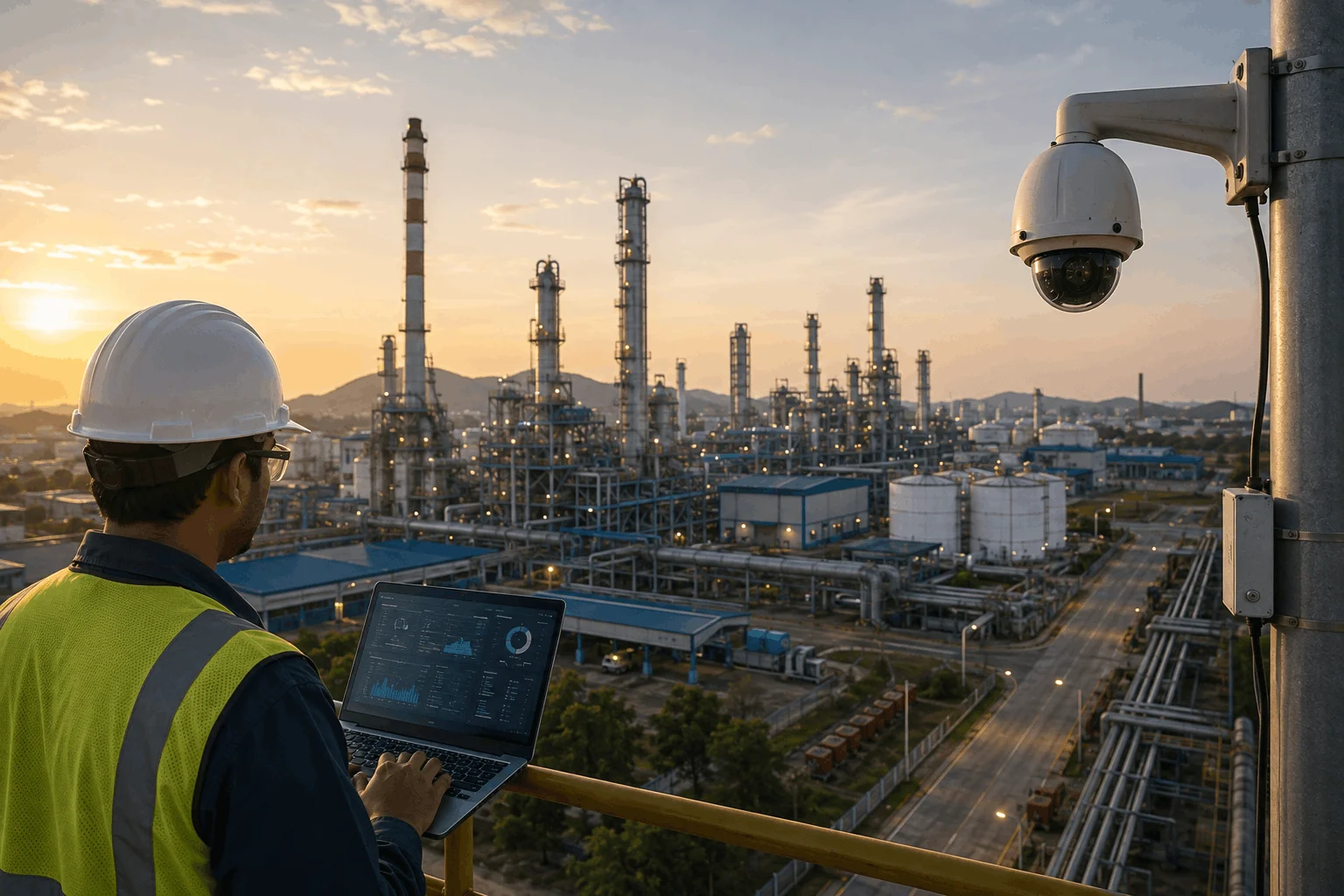
Industrial security engineering requires more than installing cameras, access control systems or communication equipment. Critical infrastructure operates across complex locations where environmental conditions, operational risks and technical requirements demand careful planning and specialised engineering.
Power plants operate across remote regions. Mining projects extend over difficult terrain. Refineries and oil terminals function under strict safety requirements. Airports, railways, manufacturing facilities and government buildings must protect people, assets and operations without unnecessary disruption.
In these environments, technology becomes an engineering challenge rather than a simple installation exercise.
One Technology, Many Industrial Environments
The same security technologies can serve different purposes depending on the operational environment.
Video surveillance can protect a refinery perimeter, monitor a power substation or support security operations at an airport. Access control can manage employee entry into manufacturing facilities, regulate visitors at government buildings and restrict access to sensitive operational areas.
Similarly, fire detection and public-address systems can protect industrial plants while supporting emergency communication and coordinated response.
Although the underlying technologies may be similar, their design, configuration and deployment requirements can vary considerably.
Successful industrial security engineering begins with understanding the specific risks, operational requirements and security objectives of each facility.
Working Around Operational Constraints
Critical industrial sites cannot always stop operations to accommodate technology installation.
Projects may need to be completed during planned shutdown windows, within restricted operational areas or while existing systems remain fully functional.
This requires detailed coordination between engineers, site teams, operators, project managers and technology vendors.
Before deployment, several factors must be evaluated, including network infrastructure, power availability, environmental conditions, equipment placement, cable routing and future expansion requirements.
Proper planning helps minimise operational disruption while ensuring that new systems integrate effectively with existing infrastructure.
Engineering Systems for Harsh Conditions
Industrial environments can be considerably more demanding than conventional commercial buildings.
Dust, extreme heat, humidity, vibration, long distances and continuous outdoor exposure can affect equipment performance and communication networks. Remote facilities may also present additional challenges for maintenance, connectivity and technical support.
Equipment selection must therefore consider actual operating conditions rather than relying only on technical specifications.
Outdoor-rated cameras, protected network equipment, suitable enclosures, reliable power infrastructure and appropriate communication technologies all contribute to long-term system performance.
The objective is to build infrastructure that remains dependable under real operating conditions.
Integrating Multiple Security Technologies
Modern industrial facilities depend on multiple interconnected technology systems.
These may include:
- Video surveillance and intelligent video analytics
- Identity and access control systems
- Fire detection and alarm systems
- Public-address and plant communication networks
- Industrial networking and fibre connectivity
- Security management software and monitoring platforms
- Cybersecurity and data protection infrastructure
When these technologies operate independently, communication gaps and operational limitations can develop.
Integrated systems create a more coordinated environment where information can be shared, alerts can reach the appropriate teams and operators gain better visibility across the facility.
Effective integration also supports future upgrades and expansion without requiring organisations to replace their entire infrastructure.
Experience That Travels to the Field
Engineering solutions for critical infrastructure requires more than technical knowledge. It demands practical experience in understanding site conditions, coordinating complex installations and managing different operational requirements.
SCORE has worked across diverse environments, including industrial plants, power projects, airports, defence programmes, government facilities and remote locations.
This experience helps the team recognise that every project presents different challenges. The right solution depends on the environment, operational priorities, security requirements and long-term objectives.
Beyond Installation: Long-Term Engineering Responsibility
The successful commissioning of a system is only one stage of its lifecycle.
Equipment requires regular maintenance. Software needs updates. Networks evolve. Facilities expand. Security requirements change. Operational teams also need ongoing technical support.
A reliable industrial security infrastructure must be designed with these future requirements in mind.
Planning for maintenance, system upgrades, technical support and future integration helps organisations protect their investment and maintain consistent operational performance.
For SCORE, engineering responsibility extends beyond installation and handover. Design, deployment, integration and maintenance are part of the same commitment.
Because critical infrastructure deserves security technology that is engineered to perform, built to last and supported throughout its operational life.